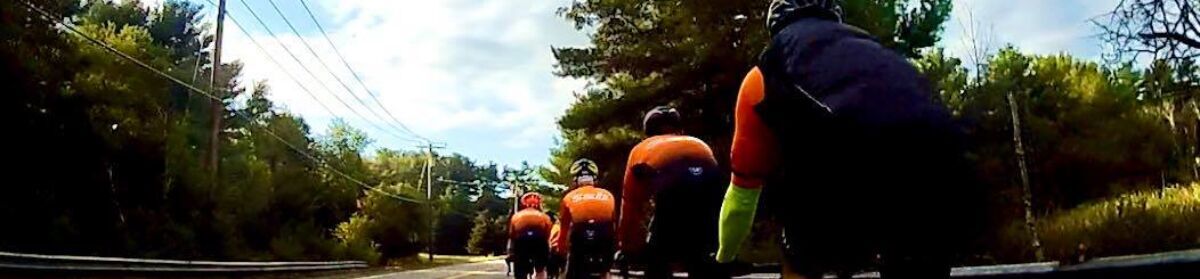
Paceline Tips

SSB runs different rides with the touring group and more structured rides from casual riding along the road to 8,000-mile-per-year riders that crave paceline riding.

  • Stay on the right side of the road way. If you see an upcoming obstacle slowly move to the left of the obstacle.
  • Keep your speed smooth and steady. Don’t jam on the brakes – feather them. Don’t coast – soft pedal. Be predictable in everything you do.
  • Stay about half a wheel back from the rider in front. If you don’t trust the rider in front – or yourself – increase the gap a bit.
  • Don’t overlap wheels. In other words, don’t let your front wheel be alongside another rider’s rear wheel. Stay behind their wheel. Don’t be off to the side.
  • Listen and watch for signals, especially in larger groups:
    • “Car up” means there’s a car ahead in the opposite lane; “car back” means one is about to overtake.
    • “Runner up” means there is someone running towards the paceline.
    • Left and right turns are indicated by the standard hand signals: left hand out for left turn, left hand up or right hand out for right turn. Stop or slowing are indicated by right hand down, palm back.
    • Pointing down means “road hazard”: a hole, storm drain, or whatever. Sand and glass usually elicit verbal comment. A rider to the left of the paceline pointing to a space between bikes is saying “Lemme in!”
  • If the situation does call for increasing speed, do it gradually. Speeding up quickly stretches out the line like a spring, stressing everybody as it comes back together.
  • Turn the pedals 30 times at the front. More is not necessary and perhaps counterproductive.
  • Stay out there too long and you’ll find that it’s the most common way to get dropped from your pack; you’ll be too tired to stay connected to the end of the train, and you’re history.
  • When you’re making your way back, stay close to the line – you’ll still get some benefit from the draft. Soft pedal. Keep pedaling but easy.
  • When you’re pulling off the front, do not slow or stop pedaling as you begin to pull off, lest the person behind you run into your wheel. Save enough energy to make sure you’re continuing to “pull” off the front of the line.
  • Finally, you made it to the back again. Time to sit in, eat and drink, shake out your hands.

Upcoming rides

Rides for 8/29 are cancelled. We will have an extra Marion ride on 8/30 at 7 AM and the Marshfield ride at 8 AM.

Next week the start time for the rides will advance to 8 AM. The A group will be riding a 42 mile course at 8AM. The route of the day will alternate between the Duxbury, Coastal alternative, or the cranberry loop. The B group will follow the Coastal 37 mile loop.

When using Strava via the mobile app, if you click on the third tab for the club the feed displays. However, if you click on the button with the actual name of the club, then you will see the rides listed on Strava. You can register for rides on the mobile app. On the web version, you can click onto the route page from the event page and star the route. When you star the route, then it automatically synchronizes to your Garmin or Wahoo device.

The Martha’s Vineyard Tour will be in September. Please register at https://www.strava.com/clubs/186760/group_events/634866

Tues 9/1
630AM 30 GZ  https://www.strava.com/clubs/186760

Fri 9/4
630AM 20 FF https://www.strava.com/clubs/186760/group_events/757834

Sat 9/5
8AM 42 Hanover https://www.strava.com/clubs/186760/group_events/782661
8AM 37 Hanover https://www.strava.com/clubs/186760/group_events/785319

Sat 9/6
8AM 50 Halifax https://www.strava.com/clubs/186760/group_events/785320

Weekly rides 2020

The weekly rides will return in 2020. At the membership meeting on 1/4/2020, we planned the following rides. The start date for the Marshfield ride has not been set, yet.

  • Blue Hills weekly on Wednesdays
  • Hanover rides weekly on Saturdays
  • Halifax rides every other Sunday
  • Alternative starts every other Sunday
  • Thursday Time Trial will be every other Thursday starting 5-14-2020

The Blue Hills ride will be focused more on hill workouts. The first ride will be on 4-15-2020. The meeting spot will be the free public parking lot at Houghton’s Pond on Hillside street in Milton. Workouts will include the option of the classic loop, repeats on the access road, and repeats on Chickatabot road in Quincy.

The Hanover ride will start from Route 53 by the BikeWay. The first rides will be on 4-18-2020. The first group will leave at 7AM. The Women’s group and the moderate pace group will roll at 8 AM. The front group will use the 50 mile route starting on 6-2-2020. The standard 37 mile route will on 4-18-2020.

The Halifax ride will start from Route 58 and Route 106 in Halifax. Park at the Cumberland Farms. The first ride will be on 4-19-2020. We will run this ride every other Sunday. The standard route to Marion will be used.

The Thursday Time Trials will start on 5-14-20 from Halifax. A route map is being made by Mr. Chris Corbin. Mr. Corbin will be the time trial manager.

Suggestions for alternative ride starts should be sent to Mrs. Liz Malone-O’Hara or Mrs. Wendy Torkelson. The alternative rides will allow members to showcase different routes or for the club to participate in rides with other clubs.

Pacelining tips

Think of paceline riding as team riding. It requires cooperation and a lot more than just keeping up. It calls for focused attention, taking responsibility and leading. When riding in a paceline observe the following:

  • Ride to the right − pull off to your left.
  • Ride in a straight line following the rider in front of you.  Do not swerve or brake without warning. Pedal through bumps in the road − do not swerve around them. Don’t panic and jam on your brakes − the bike behind will run right up your rear wheel. Feather your brakes to modulate speed.
  • Always Pedal.  No coasting.  Always pedal down hills.
  • Keep your head up and your eyes scanning up the road as much as possible. Do not get hypnotized by the wheel in front of you. Use your peripheral vision to monitor the wheel in front of yours while you watch the road and riders ahead. You can then better see the paceline slowing or accelerating, as well as traffic lights and stop signs and you will be better prepared to react to any situation.
  • Do not overlap the rear wheel of the bike in front of you.  Keep your wheel in line with the rear wheel in front of you.
  • Keep the same distance between you and the rider in front of you.  If it requires more energy momentarily, expend it.  Don’t create a yo-yo.  It makes it much harder for the folks behind you, if you open a gap.
  • When at the front of the group, pedal smoothly at all times, even down hills. You will need to keep pedaling on the down hills so that the bikes in back of you do not have to brake in order to avoid riding up your rear wheel.
  • When at the front you are the eyes of the paceline. Watch for hazards. Ideally you will see a hazard far enough in advance to move the path of the paceline well clear of it. Call out obstacles or holes in the road as well as your intentions to slow or stop. Every rider in the paceline is depending on you − you at the front of the line. Not every single hole warrants a shout. Call out hazards, don’t call out little bumps. Ride through rough spots by rising slightly off your saddle and pedaling through.
  • When at the front of the paceline and it is time to pull off, maintain the same steady pace.  Move to the side.  When clear of the paceline connect to the back of the line.  Pull in behind the last bike.
  • Stay at the front only for as long as you’re directed, shorter if you are feeling tired. When a rider has pulled off and approaches the back of the group the last rider should call “LAST” so the rider coming back won’t have to chase to get back on.
  • When taking the lead in a paceline do not surge or pick up the overall pace. Maintain the same speed as when drafting. As you take over you will naturally have to put out more effort. Learn to finesse your effort in order to maintain a smooth transition as you take over. If you are tired, make your turn at the front as short as possible. No one has to prove anything at the front.
  • A great group works together! We keep the people together.  We ride at 20.25 instead of 21mph, if everyone can hang together.